Oil Edges Higher as Strait of Hormuz Closure Keeps Markets Cautious
WTI crude nudged up 0.7% Friday as US-Iran tensions left the Strait of Hormuz in de facto closure, while European equities drifted and investors eyed next week's US CPI.
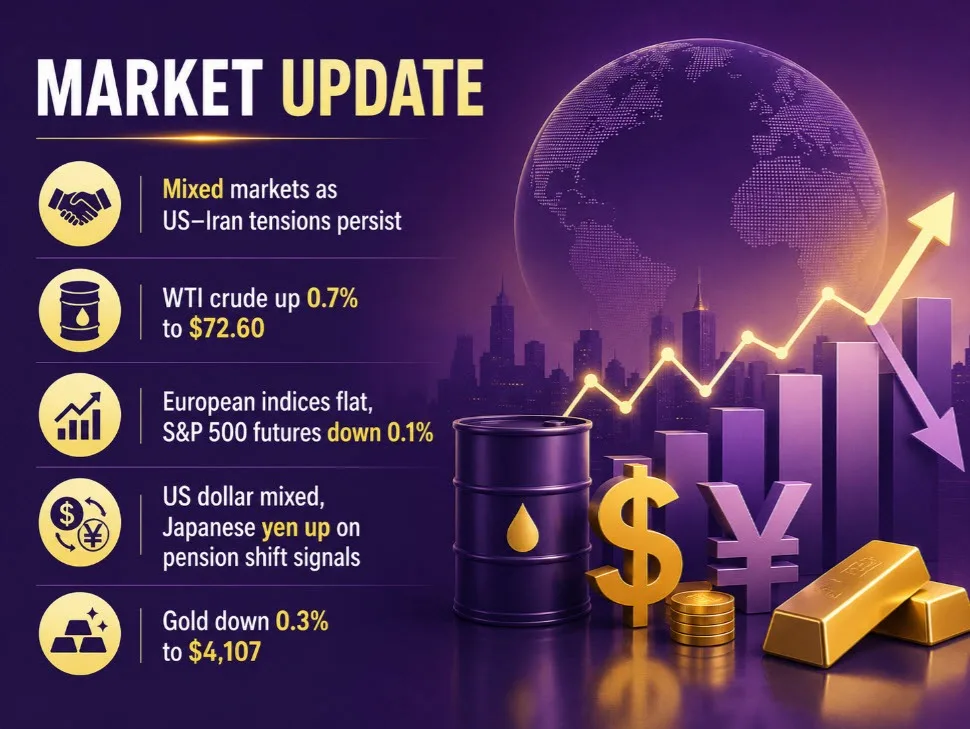
Geopolitical risk remained the dominant undercurrent in global markets Friday as the Strait of Hormuz stayed effectively closed amid unresolved US-Iran tensions. A US official offered a flicker of optimism by suggesting that negotiations were not entirely off the table, but the practical reality — a critical chokepoint for global energy flows now restricted — continued to cast a shadow over commodity and equity trading alike. According to the IEA, global oil supply rose 4.1 million barrels per day in June as Hormuz flows partially resumed, yet output remained 9.4 million bpd below pre-war levels, underscoring just how much structural damage the standoff has already inflicted on supply chains.
WTI crude reflected those tensions by climbing 0.7% to $72.60 a barrel, a modest but telling gain given the broader low-volatility tone of the session. European equity indices finished largely flat, while S&P 500 futures slipped 0.1% and Nasdaq futures retreated 0.3%, suggesting technology shares were quietly digesting the week's uncertainty rather than making any bold directional bets. With US earnings season approaching, the cautious posture across equities carries an added layer of meaning — investors appear reluctant to build significant positions ahead of what could be a pivotal reporting cycle.
Read more Single-Stock ETFs Are Pushing Leverage to Its Limits →
In currency markets, the Japanese yen stood out as the session's notable mover, with USD/JPY dropping 0.3% to 161.80 after Japan signaled a significant pension portfolio reallocation. The dollar was otherwise subdued, with EUR/USD flat at 1.1430 and GBP/USD marginally higher at 1.3425. The Swiss franc also lagged, a mild signal that safe-haven demand, while present, was not surging. Meanwhile, gold slipped 0.3% to $4,107 and silver fell 0.9% — a counterintuitive pullback for metals typically buoyed by geopolitical stress, though it may reflect profit-taking after a strong stretch.
On the macro calendar front, Germany confirmed headline annual inflation at 2.3% for June while French inflation also fell, both outcomes that ease near-term pressure on the European Central Bank. The Bank of Japan, separately, is expected to hold rates steady at its July meeting while maintaining tightening guidance. All eyes now turn to the US CPI report for June, due July 14, which stands as the most consequential near-term data point for Federal Reserve rate expectations and, by extension, global risk sentiment heading into the summer.
Continue reading at Forexlive.