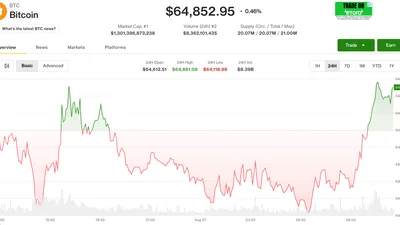
Bitcoin's Calm Surface Masks Deeper, Unresolved Risks
Bitcoin's volatility has dropped sharply, but analysts warn that suppressed price swings don't mean the underlying risks have faded.

There is a peculiar comfort markets take in stillness. When an asset stops lurching violently in either direction, investors tend to interpret the quiet as a signal of maturity, stability, or at least safety. Bitcoin has recently offered exactly that kind of calm — and exactly that kind of misreading.
The cryptocurrency's volatility has fallen to unusually low levels by historical standards, a development that superficially resembles the behavior of a maturing asset class. But reduced volatility in speculative markets is not the same as reduced risk. If anything, prolonged periods of compressed price movement can be a precursor to sharp dislocations, as positioning becomes crowded and complacency sets in among traders who interpret the absence of turbulence as an all-clear signal.
Read more Digital Health Platform Shares Double Overnight on AI Search Surge →
The distinction matters enormously for the growing class of institutional and retail investors who have entered the Bitcoin market in recent years, many of them through regulated vehicles like spot ETFs. These participants may be calibrating their risk exposure based on recent realized volatility — a backward-looking measure that captures what has happened, not what is possible. Bitcoin's underlying risk profile, shaped by its still-limited liquidity relative to traditional assets, its sensitivity to regulatory shifts, and its reflexive relationship with market sentiment, has not structurally changed simply because prices have moved sideways.
Volatility, in financial terms, is a measure of uncertainty — not of danger itself. A coiled spring is not a safe spring. Markets that have been artificially or temporarily quieted can reprice with speed and severity that surprises even experienced participants. For Bitcoin specifically, the historical record shows that extended low-volatility regimes have frequently resolved in dramatic fashion, in both directions. That asymmetry deserves serious weight in any honest risk assessment.
The broader implication is that the current environment may be precisely the wrong moment for investors to reduce their vigilance. Treating Bitcoin's newfound calm as a permanent condition rather than a temporary state would be a category error — one with potentially costly consequences when price action eventually resumes. Continue reading at CoinDesk.